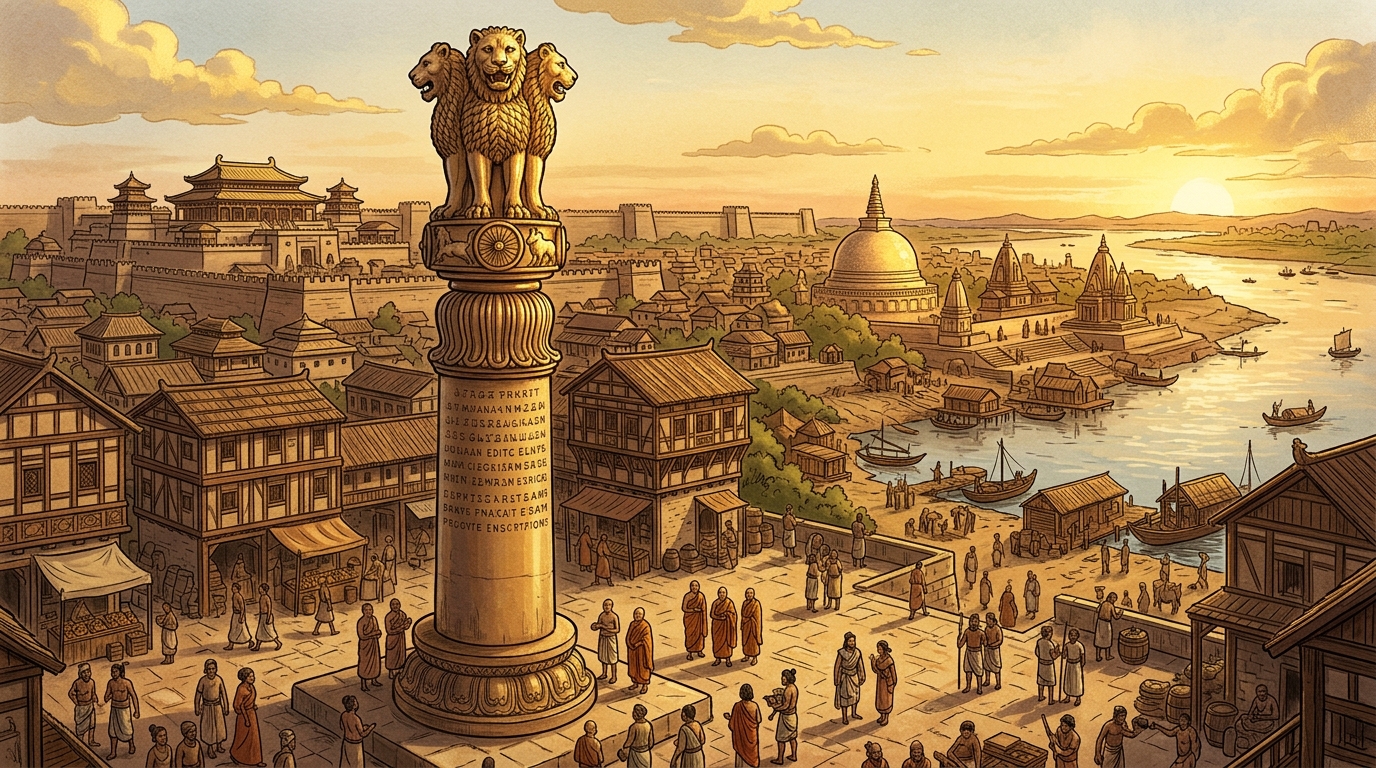
The Maurya Empire (321 – 185 BCE) was the first pan-Indian imperial powerhouse, stretching from the rugged Hindu Kush in modern Afghanistan down to the southern plateau of Mysore, and from Bengal to the Arabian Sea.
Founded by Chandragupta Maurya with the strategic genius of Chanakya (Kautilya), and later immortalized by the moral governance of Emperor Ashoka, the Mauryan state set benchmarks in diplomacy, civic infrastructure, and legal governance that echoed across centuries.
Key Rulers of the Maurya Dynasty
| Ruler | Reign | Notable Achievements |
|---|---|---|
| Chandragupta Maurya | 321 – 297 BCE | Overthrew Nanda Dynasty, defeated Seleucus I Nicator, unified Northern India |
| Bindusara | 297 – 273 BCE | Known as Amitraghata (Slayer of Foes), expanded into the Deccan peninsula |
| Ashoka the Great | 268 – 232 BCE | Conquered Kalinga, adopted Buddhism, formulated Ashoka's Dhamma, erected Rock & Pillar Edicts |
| Brihadratha | 187 – 185 BCE | Last Mauryan ruler, assassinated by his commander Pushyamitra Shunga |
Chanakya and the Arthashastra
Behind the rise of Chandragupta stood Chanakya (also known as Kautilya or Vishnugupta), a scholar of political science and economics at the ancient university of Taxila. He authored the Arthashastra, a groundbreaking treatise on statecraft, economic policy, and military strategy.
Key concepts introduced by the Arthashastra include:
- The Saptanga Theory: Viewing the state as an organism with seven limbs: the King (Swami), Ministers (Amatya), Territory/Population (Janapada), Forts (Durga), Treasury (Kosha), Army (Danda), and Allies (Mitra).
- Espionage Network: A sophisticated intelligence network employing spies across all social strata to maintain internal order and preempt subversion.
- Regulated Economy: State control of mining, metallurgy, forests, and alcohol production, ensuring stable state revenue.
Centralized Administrative Structure
The capital at Pataliputra (modern-day Patna, Bihar) was described in awe by the Greek ambassador Megasthenes in his book Indika. Surrounded by a massive wooden palisade with 570 towers and 64 gates, the city was administered by a municipal council of thirty commissioners divided into six committees overseeing sanitation, industries, foreign visitors, birth/death records, trade, and tax collection.
The vast empire was divided into four administrative provinces governed by royal princes (Kumara):
- Taxila — Northwestern province managing Silk Route connections
- Ujjain — Western province controlling maritime trade routes
- Tosali — Eastern province (in coastal Kalinga)
- Suvarnagiri — Southern province managing rich gold mining tracts
The Turning Point: Kalinga War and Ashoka's Dhamma
In 261 BCE, in the eighth year of his reign, Ashoka launched a conquest of Kalinga (modern-day Odisha). The war caused immense bloodshed—over 100,000 casualties and 150,000 deportations. Seeing the devastation filled Ashoka with profound grief and repentance.
He renounced military conquest (Bherighosha) and committed his empire to moral conquest through righteous living (Dhammaghosha). His policy of Dhamma was not a dogmatic religion but an ethical civic code emphasizing:
- Compassion and non-violence toward animals and humans (Ahimsa)
- Respect for parents, teachers, and elders
- Fair and humane treatment of servants and prisoners
- Interfaith harmony and mutual respect among diverse religious sects
Art and Architectural Legacy
Mauryan court art introduced monumental stone sculpture to India. The monolithic Ashoka Pillars, carved from single blocks of Chunar sandstone and polished to a mirror-like sheen, represent masterpieces of ancient sculpture. The Lion Capital of Sarnath, featuring four back-to-back lions standing upon an abacus with the Wheel of Law (Dharma Chakra), was adopted as the Official National Emblem of India in 1950.
Frequently Asked Questions
Conclusion
The Maurya Empire proved that a diverse subcontinent could be integrated not just through military might, but through compassionate governance and institutional integrity. Ashoka’s ethical message remains a timeless guide for world leadership.
Next in History: Gupta Empire: The Golden Age of Ancient India · Overview of Ancient India · Nalanda University