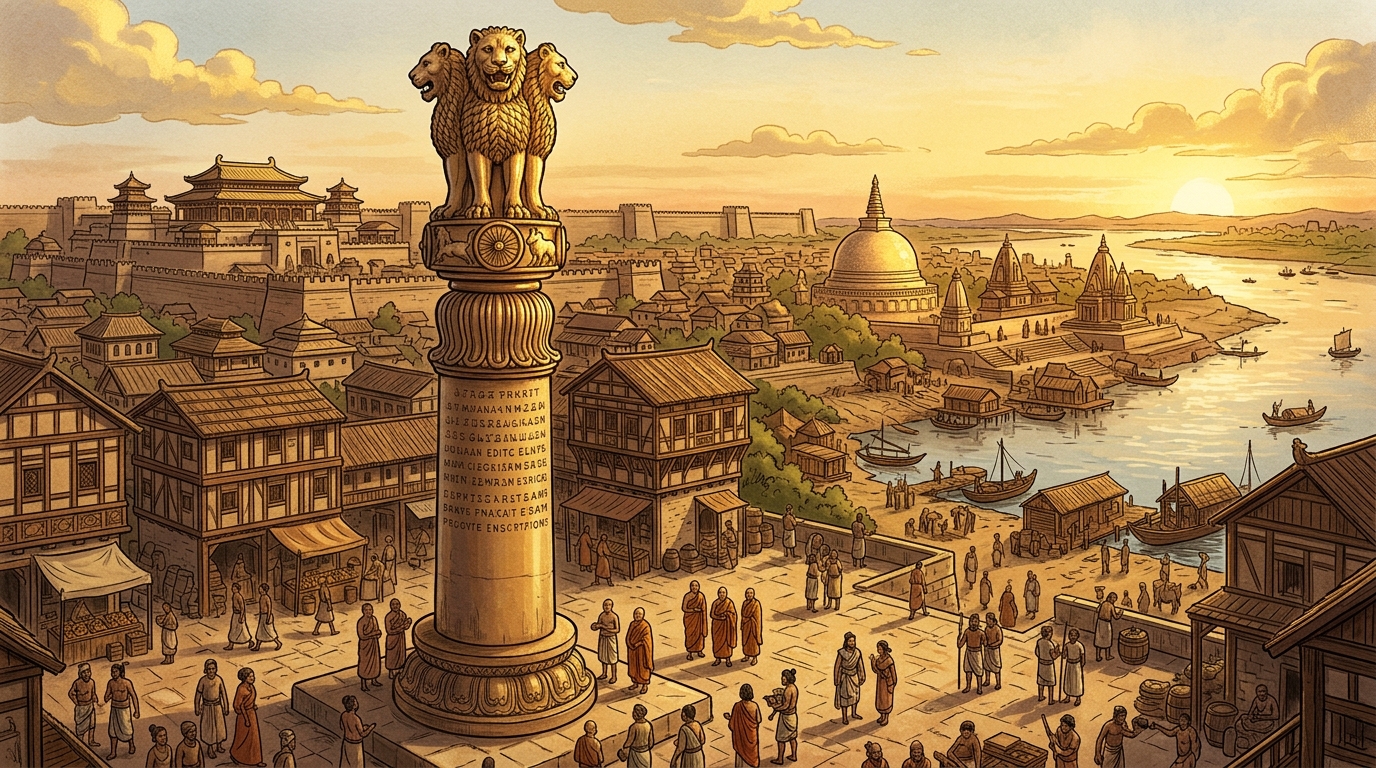
For nearly eight centuries, Nalanda University stood as the greatest centre of learning the ancient world had ever seen. Scholars came from China, Korea, Japan, Tibet, Mongolia, Turkey and Sri Lanka — all to study at a single campus in the state of Bihar, India.
Today, its ruins are a UNESCO World Heritage Site and a living symbol of India's intellectual heritage. Understanding Nalanda helps us appreciate just how advanced ancient Indian scholarship was — and what the world lost when the university was destroyed.
Where Is Nalanda Located?
Nalanda is situated in the Nalanda district of Bihar, India — approximately 95 kilometres south-east of the state capital, Patna. The site lies near the town of Rajgir, another historically important place in ancient India.
The region was part of the ancient Magadha kingdom, one of the most powerful kingdoms of early India. Its location in the fertile Gangetic plains made it accessible and well-resourced.
History of Nalanda University
Nalanda's origins date to the 5th century CE, during the reign of the Gupta Empire. According to historical accounts, the university began as a monastery established near the birthplace of Mahavira, the founder of Jainism.
Foundation and the Gupta Period
The Gupta emperors — particularly Kumaragupta I — are credited with establishing Nalanda as a major monastic centre. The Guptas were generous patrons of art, science and religion, and Nalanda flourished under their support.
By the 5th and 6th centuries CE, Nalanda had grown into a full university with lecture halls, libraries, dormitories and meditation halls spread across a large campus.
The Peak Years: 6th–12th Century
Nalanda reached its peak between the 6th and 12th centuries, attracting over 10,000 students and 2,000 teachers at its height. Chinese travellers Xuanzang (Hiuen Tsang) and Yijing, who visited the university in the 7th century, left detailed accounts describing its scale and grandeur.
Xuanzang spent several years studying at Nalanda and recorded that the institution had eight separate compounds and ten temples. The library — known as Dharmaganja or "Treasury of Truth" — reportedly contained three large buildings filled with manuscripts.
Subjects Taught at Nalanda
| Field | Subjects Covered |
|---|---|
| Philosophy | Buddhist philosophy, Vedic philosophy, logic |
| Sciences | Mathematics, astronomy, medicine |
| Languages | Sanskrit, Pali, grammar |
| Arts | Fine arts, architecture, sculpture |
| Religion | Buddhist texts, Hindu scriptures, Jain philosophy |
Admission to Nalanda was highly competitive. According to Xuanzang, only about 20% of applicants passed the entrance examination conducted at the gate by a scholar. Students who could not answer the gatekeeper's questions were turned away.
Notable Scholars of Nalanda
Over its long history, Nalanda produced or hosted some of the most important minds in ancient scholarship:
- Nagarjuna – One of the most important Buddhist philosophers, said to have studied and taught at Nalanda
- Aryabhata – The mathematician who calculated the value of pi and proposed a heliocentric model of the solar system is believed to have been associated with Nalanda
- Dharmakirti – A major Buddhist logician whose work shaped philosophy across Asia
- Xuanzang (Hiuen Tsang) – The famous Chinese scholar who studied here and took thousands of Buddhist manuscripts back to China
- Atisa – The 11th-century Buddhist scholar who later spread Buddhism in Tibet
The Destruction of Nalanda
In approximately 1193 CE, Nalanda was attacked and destroyed by forces led by Bakhtiyar Khilji, a military commander of the Delhi Sultanate. The destruction was catastrophic — the library was burned, and accounts suggest the fire burned for three months. Monks were killed or expelled.
This event is often cited as one of the greatest losses in the history of world scholarship. Countless manuscripts containing centuries of accumulated knowledge were destroyed.
The Nalanda University Revival
In 2014, a modern Nalanda University was established near the original site, supported by the Government of India and several East Asian governments. The initiative aimed to revive the spirit of Nalanda as an international centre of learning — though it has been a slow and complex project.
UNESCO World Heritage Status
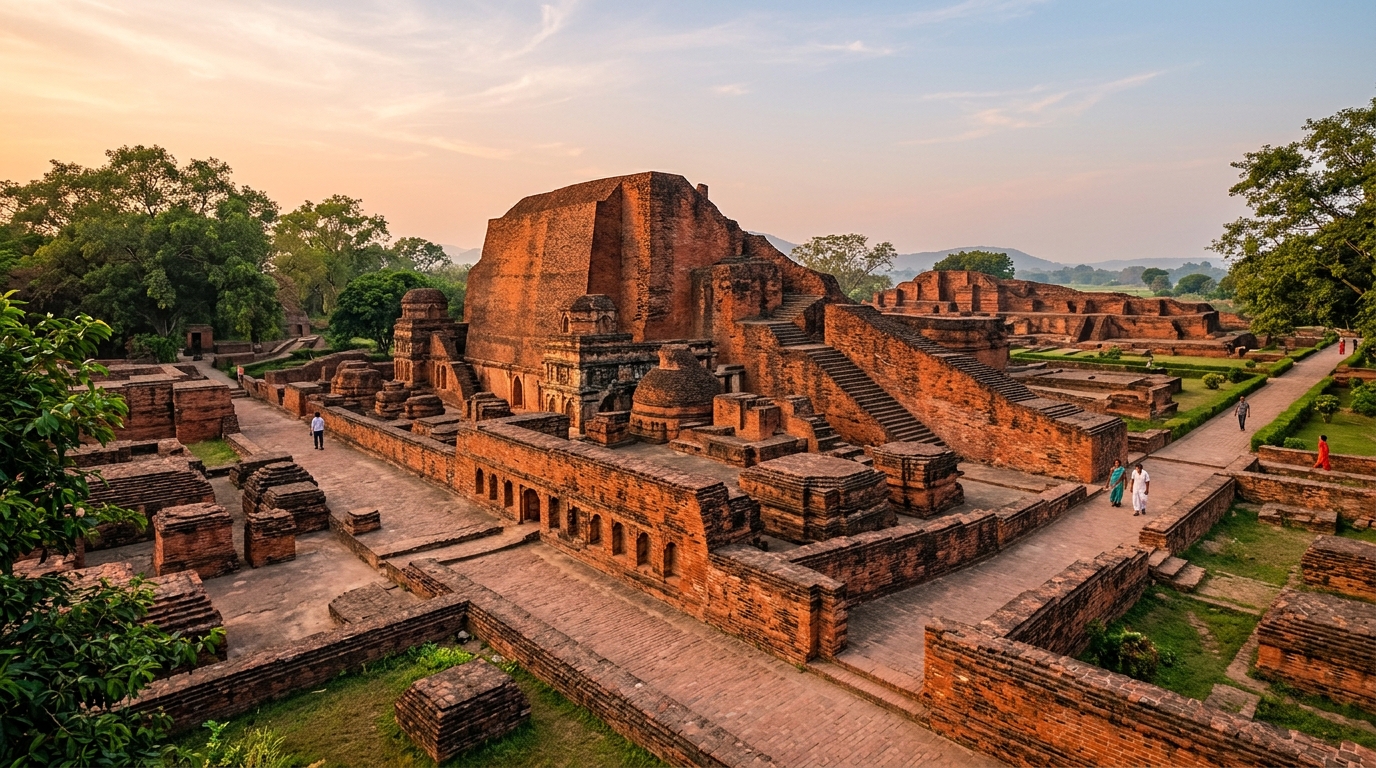
The archaeological site of Nalanda Mahavihara was inscribed as a UNESCO World Heritage Site in 2016. The site contains ruins of monasteries and temples built between the 3rd century CE and the 13th century CE, spread across a large area.
Visitors today can walk through the red-brick ruins, see the remains of lecture halls and dormitories, and visit the adjacent Nalanda Archaeological Museum, which displays statues, coins and inscriptions excavated from the site.
Frequently Asked Questions
Conclusion
Nalanda University represents one of humanity's greatest intellectual achievements. For nearly 800 years, it served as a global centre of knowledge — open to students of all backgrounds and from every corner of Asia. Its destruction was an irreplaceable loss, but its legacy continues to inspire educational institutions worldwide.
Visiting the ruins of Nalanda today is a humbling experience. The red-brick structures that remain tell the story of a place that once held the accumulated wisdom of a civilisation — and remind us of how fragile knowledge can be.
Related Articles: Maurya Empire · Gupta Empire: The Golden Age · History of Ancient India · Historical Places in Bihar