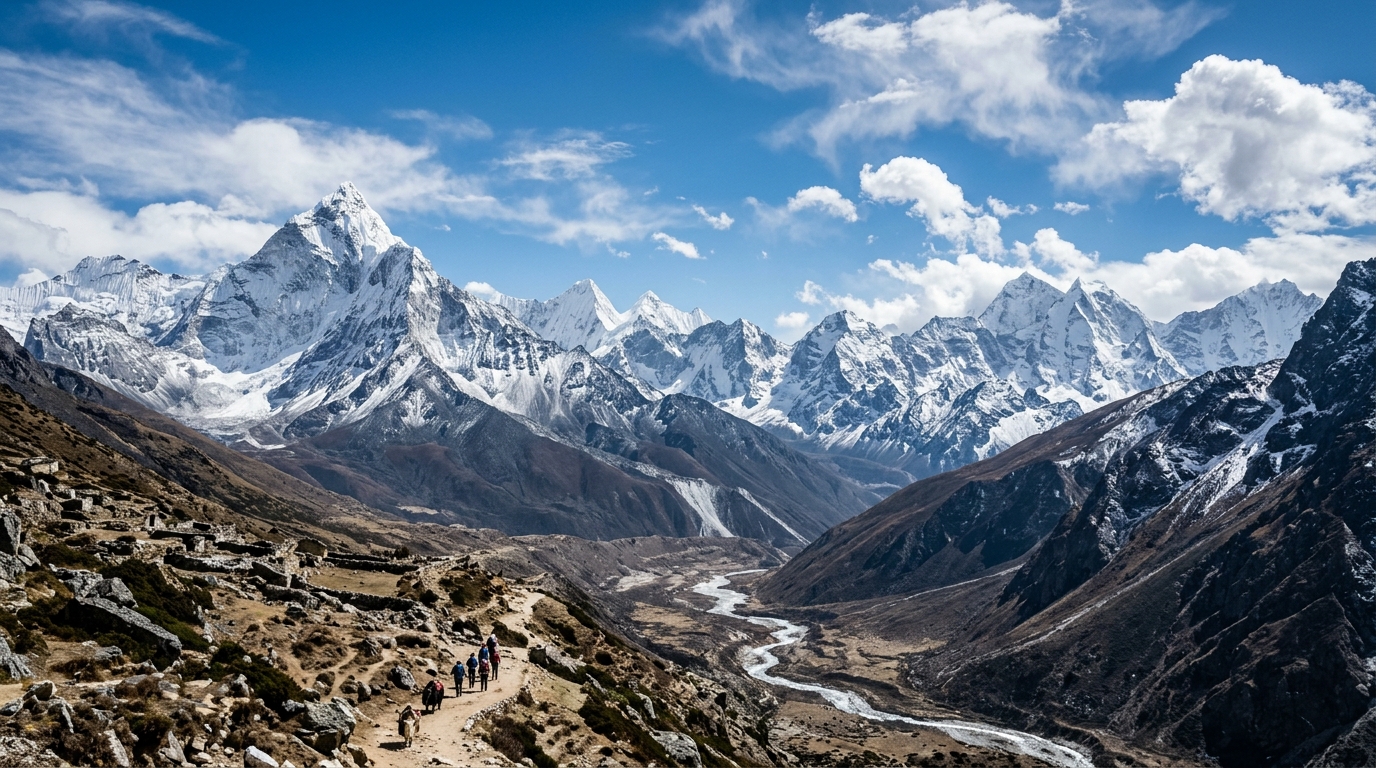
Stretching across 2,400 kilometers in a majestic arc from the Indus gorge in the west to the Brahmaputra bend in the east, the Himalayas are the youngest, highest, and most rugged fold mountains on Earth.
Formed by the violent collision of the Indian tectonic plate with the Eurasian plate around 50 million years ago, the Himalayas continue to rise at approximately 5 millimeters per year. They act as the "Third Pole" of the planet, storing more glacial ice than anywhere outside the Arctic and Antarctic, and serving as the primary climate determinant of the Asian continent.
The Three Parallel Longitudinal Ranges
| Range Name | Sanskrit Name | Average Elevation | Key Features & Peaks |
|---|---|---|---|
| Greater Himalayas | Himadri | 6,000+ meters | Perennial snows, Mount Everest (8,848.86 m), Kanchenjunga (8,586 m), Nanda Devi (7,816 m) |
| Lesser Himalayas | Himachal | 3,700 – 4,500 m | Pir Panjal, Dhauladhar, famous hill stations (Shimla, Manali, Mussoorie, Darjeeling) |
| Outer Himalayas | Shiwalik | 900 – 1,100 m | Unconsolidated sediment gravels, longitudinal flat valleys called Duns (e.g., Dehradun) |
1. The Greater Himalayas (Himadri)
The northernmost and highest spine of the system is the Himadri. Composed primarily of granite core flanked by metamorphic schists, it contains all the world's fourteen peaks exceeding 8,000 meters ("eight-thousanders"). Glaciers such as the Gangotri (source of Ganga), Yamunotri, and Siachen (the world's longest non-polar glacier at 76 km) originate in this range.
2. The Lesser Himalayas (Himachal)
Lying south of the Himadri, the Himachal range features rugged topography dissected by deep river valleys. The longest range is the Pir Panjal in Jammu & Kashmir and Himachal Pradesh. Famous for its salubrious temperate climate, pine forests, and alpine meadows known as Marg (e.g., Gulmarg, Sonamarg) or Bugyal in Uttarakhand.
3. The Shiwaliks (Outer Himalayas)
The outermost foothills border the northern plains. Composed of tertiary gravels, boulders, and silt washed down by rivers, the Shiwaliks are geologically young and prone to landslides and seismic activity. The longitudinal tectonic valleys separating the Shiwaliks from the Lesser Himalayas are termed Duns in the west (Dehradun, Kotli Dun, Patli Dun) and Duars in the east (leading toward Bhutan).
Climatic Importance: The Shield of South Asia
The Himalayas exert a profound influence on global and regional meteorology:
- Monsoon Catalyst: The towering barrier intercepts moisture-laden Southwest Monsoon winds blowing from the Bay of Bengal and Arabian Sea, forcing them to rise (orographic uplift) and dump life-giving torrential rain across northern and central India.
- Cold Siberian Barrier: During winter, the Himalayas physically block the bitter, freezing polar air masses originating in Siberia and Central Asia from sweeping into northern India, keeping the subcontinent warm compared to other regions at identical latitudes.
- Water Tower of Asia: The snowmelt and glaciers feed ten of Asia's largest river basins—including the Indus, Ganga, Brahmaputra, Yangtze, and Mekong—supplying freshwater and food security to nearly 2 billion people.
Frequently Asked Questions
Conclusion
The Himalayas represent more than physical grandeur; they are the climatic thermostat, freshwater reservoir, and ecological bedrock of South Asia. Understanding and mitigating the effects of climate change on Himalayan glaciers is one of humanity’s most urgent environmental imperatives.
Next in Geography: Indian Monsoon: How It Works & Why It Matters · Major Rivers of India · Physical Geography of India