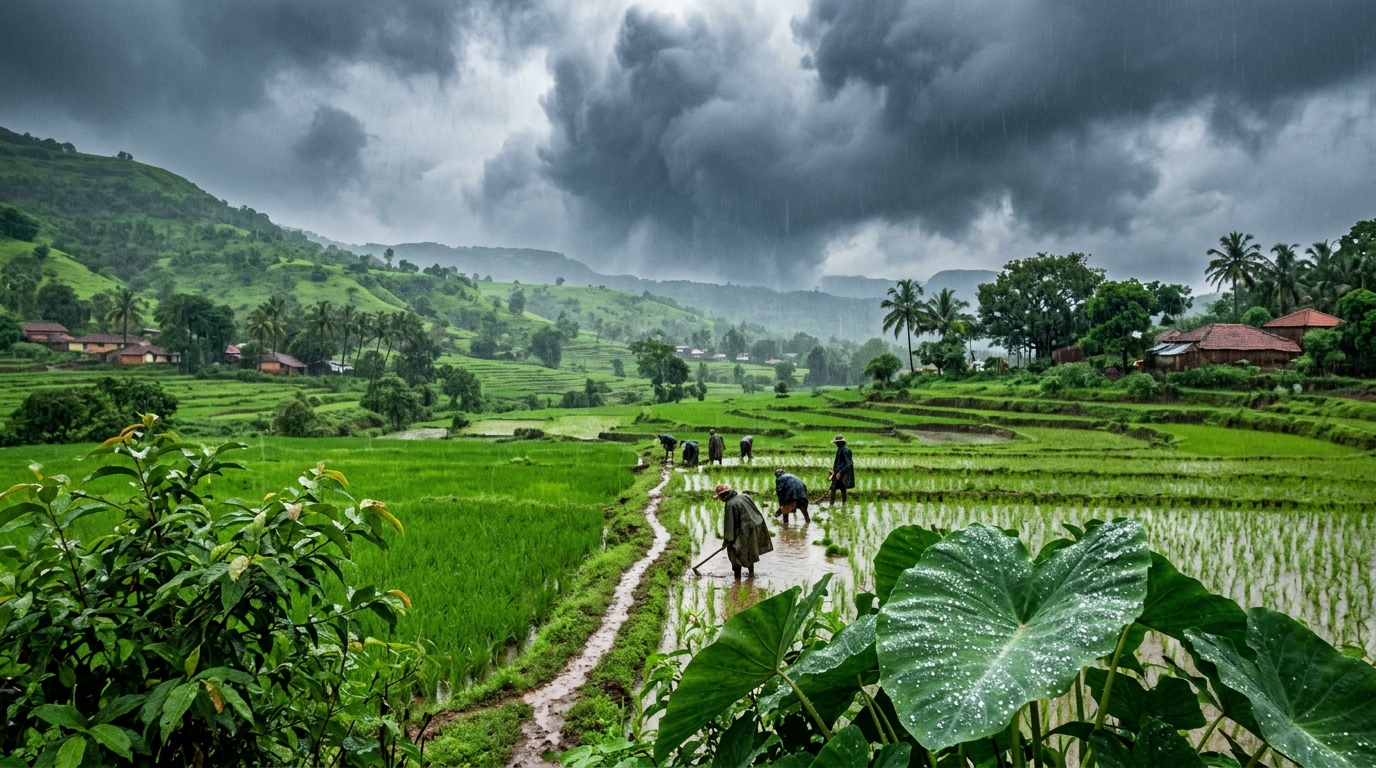
The word "monsoon" originates from the Arabic term Mawsim, meaning season. It refers to the dramatic seasonal reversal in the direction of winds over South Asia and the Indian Ocean, delivering more than 70% of India's annual precipitation between June and September.
Far from a simple rain shower, the Indian monsoon is one of the most powerful and complex thermodynamic heat engines on Earth. It dictates agrarian food yields, fills hundreds of hydroelectric reservoirs, and directly influences the macroeconomic growth rate of the entire subcontinent.
Comparison: Southwest vs. Northeast Monsoon
| Characteristic | Southwest (Summer) Monsoon | Northeast (Winter) Monsoon |
|---|---|---|
| Period | June to September | October to December (Retreating phase) |
| Wind Direction | South-West to North-East (Ocean to Land) | North-East to South-West (Land to Ocean) |
| Moisture Content | Extremely high (travels over warm Indian Ocean) | Dry over land; picks moisture over Bay of Bengal |
| Primary Beneficiary | Over 80% of mainland India (Western Ghats, NE, Gangetic Plain) | Coromandel Coast (Tamil Nadu, coastal Andhra Pradesh) |
| Major Crops | Kharif crops (Rice, Cotton, Soybeans, Maize) | Rabi crops (Wheat, Mustard, Winter pulses) |
The Core Mechanism: How the Monsoon Works
The monsoon is driven by several interrelated planetary and regional atmospheric dynamics:
1. Differential Heating of Land and Sea
During the northern hemisphere summer, the massive landmass of northern India and the Thar Desert heats up intensely, generating a thermal low-pressure trough over northwest India. In contrast, the southern Indian Ocean remains relatively cool, maintaining high atmospheric pressure. Wind naturally blows down the pressure gradient from high pressure (ocean) to low pressure (land).
2. Shift of the Intertropical Convergence Zone (ITCZ)
In July, the ITCZ—the equatorial trough of low pressure where northeast and southeast trade winds meet—migrates northward over the Gangetic Plain (known as the Monsoon Trough). As the Southeast Trade winds from the southern hemisphere cross the Equator, the Coriolis effect deflects them to the right, transforming them into the moisture-packed Southwest Monsoon.
3. The Tibetan Plateau as a Thermal Engine
The vast Tibetan Plateau, elevated over 4,500 meters above sea level, heats intensely during summer through insolation. It acts as an elevated heat pump, creating strong convective vertical air currents that push air upwards and fuel the Tropical Easterly Jet stream aloft, which reinforces the surface monsoon inflow over India.
The Two Branches of Southwest Monsoon
Upon reaching the southern tip of peninsular India at Kanyakumari, the monsoon divides into two distinct streams:
- The Arabian Sea Branch: Strikes the Western Ghats perpendicularly. Forced upwards, it releases catastrophic orographic rain (over 250 cm) on the windward coastal belt of Kerala, Karnataka, and Maharashtra, leaving the Deccan plateau on the leeward side in a rain shadow.
- The Bay of Bengal Branch: Moves northward up the Bay of Bengal, strikes the Arakan Yoma hills in Myanmar and the Khasi Hills of Meghalaya. It funnels into Mawsynram and Cherrapunji—the wettest inhabited places on Earth, averaging over 11,000 mm of annual rainfall—before deflecting westward along the Himalayas down the Gangetic Plain.
Global Climatic Drivers: El Niño and IOD
The predictability of the monsoon is influenced by planetary oceanic phenomena:
- El Niño Southern Oscillation (ENSO): An anomalous warming of sea surface temperatures in the central and eastern equatorial Pacific typically weakens the Indian monsoon, often leading to agricultural droughts.
- La Niña: The cooling counterpart of El Niño, usually associated with abundant or excess monsoon rainfall across India.
- Indian Ocean Dipole (IOD): Known as the "Indian El Niño". A Positive IOD (warmer western Indian Ocean near Africa) enhances monsoon precipitation over India, while a Negative IOD tends to suppress rainfall.
Frequently Asked Questions
Conclusion
Often dubbed the "real Finance Minister of India," the monsoon remains the single most decisive climatic phenomenon affecting South Asian life, ecology, and prosperity. Understanding its shifting patterns in an era of climate change is vital for sustainable food and water security.
Next in Geography: Indian States & Geographical Features · Major Rivers of India · Himalayan Mountains